Pahari Languages: An Overview
Pahari Languages: An Overview
Overview
The word Pahari — from the Hindi and Sanskrit pahāṛ, meaning “mountain” — is a broad linguistic label applied to a constellation of Indo-Aryan languages and dialects spoken along the lower ranges of the Himalaya, stretching from eastern Nepal through Uttarakhand, Himachal Pradesh, and the Jammu region, and into parts of Pakistan. These are not a single language but a family of related speech traditions, each shaped by the deep valleys and high ridges that have historically isolated community from community, allowing local forms to flourish with remarkable distinctiveness.
Within Himachal Pradesh, the relevant branch is Western Pahari — also called the Himachali languages — and it is here that the greatest internal diversity is found. From Kangri in the Kangra Valley to Mandiyali in Mandi, Chambeali in Chamba, Kulluvi in Kullu, and Mahasu Pahari in the Shimla hills, Western Pahari encompasses well over a dozen distinct varieties, many of them mutually intelligible only with difficulty. Estimates suggest that more than 40 lakh (four million) people across Himachal Pradesh speak a Western Pahari language as their first language — a figure that exceeds the speaker base of many officially recognised Indian languages, yet which has historically been obscured because census reporting has folded these varieties under “Hindi.”
This overview introduces the Pahari languages as living heritage: not as dialects subordinate to Hindi or Punjabi, but as languages in their own right, with rich oral traditions, distinct grammars, and deep cultural roots in the Himalayan landscape.
Background and Classification
The Indo-Aryan Family Tree
The Pahari languages belong to the Indo-European family, descending through the Indo-Iranian and Indo-Aryan branches. Within Indo-Aryan, they occupy the Northern zone — a grouping of Himalayan languages distinct from the Central (Hindi-Urdu), Western (Punjabi, Gujarati), and Eastern (Bengali, Assamese, Odia) zones. The seminal Linguistic Survey of India conducted by George Grierson in the early twentieth century first classified these mountain speeches systematically, describing them as “Western hill bids” — a label that captured their geographic and linguistic specificity.
Three Branches of Pahari
Pahari is conventionally divided into three geographic branches:
- Western Pahari — spoken primarily in Himachal Pradesh and parts of Jammu, with extensions into hilly areas of Punjab, Haryana, and Uttarakhand. Includes Kangri, Mandiyali, Chambeali, Gaddi, Bilaspuri, Kulluvi, Mahasu Pahari, Sirmauri, and others. This is the most internally diverse branch.
- Central Pahari — spoken in Uttarakhand, represented principally by Garhwali and Kumaoni, the major languages of the Garhwal and Kumaon regions.
- Eastern Pahari — represented by Nepali, the official language of Nepal, which has the largest speaker base of any Pahari language and the most developed literary tradition.
The Western Pahari branch is itself subdivided. Glottolog identifies a Mahasuic (or “Nuclear Himachali”) group — including Mahasu Pahari, Jaunsari, Bangani, Hinduri, Sirmauri, and Kullu Pahari — and a Kangric-Chamealic group — including Kangri, Chambeali, Gaddi, Bilaspuri, Bhattiyali, and several Jammu varieties such as Dogri and Bhadarwahi. Mandiyali occupies a transitional position between these two clusters. Dogri, the most prominent Western Pahari language, was recognised as an official language of India in 2003 under the Eighth Schedule.
A Dialect Continuum
One of the defining features of the Pahari languages is the dialect continuum that links them. A speaker of Kangri in Kangra can typically understand the Palampuri variety with ease, and communicate with a Mandiyali speaker with moderate effort; but the intelligibility decreases steadily as one moves toward Kulluvi or Mahasu Pahari. This gradient — rather than sharp linguistic boundaries — reflects centuries of trade, migration, and cultural exchange along Himalayan routes. It also means that the boundary between “language” and “dialect” is as much political as linguistic.
Key Features
Script: From Takri to Devanagari
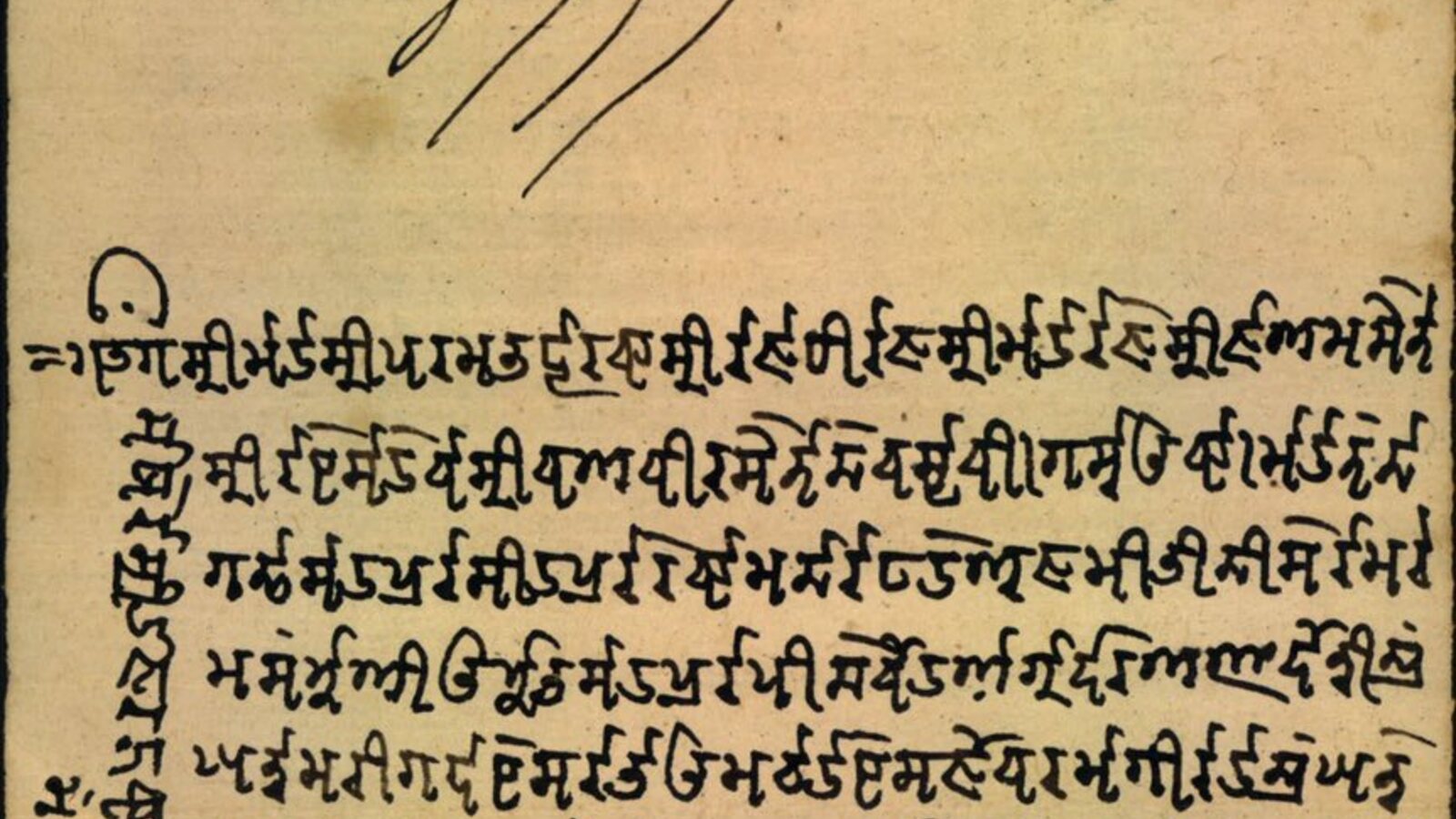
Historically, the Western Pahari languages were written in the Takri script, a regional script descended from the Sharada tradition of medieval Kashmir. Takri — and its local varieties such as Mandi-Suket Takri, Chambeali Takri, and Dogra Takri — served as the written medium for land records, religious manuscripts, and literary compositions across the western Himalayan kingdoms. The script evolved roughly between the tenth and eleventh centuries CE and remained in active use well into the colonial period.
Today, however, Takri has been almost entirely superseded by Devanagari, which is used for virtually all written Pahari material. The shift was driven by education policy, printing technology, and the administrative dominance of Hindi. A small but growing movement — including the Himachal Pradesh Department of Language, Art & Culture — has advocated for the revival of Tankri (a variant of Takri) as a cultural heritage script, and efforts are underway to digitise historical manuscripts and develop Unicode support for the script.
Linguistic Characteristics
Several features recur across the Western Pahari languages:
- Tonal systems — Kangri and Dogri, like their neighbour Punjabi, are tonal languages, using pitch contours to distinguish word meanings. This is unusual among Indo-Aryan languages and links the western Pahari group to the broader Punjab linguistic area. The tonal systems developed historically from the loss of aspirated voiced consonants.
- Rich case systems — Pahari languages preserve elaborate nominal case paradigms, often more complex than those of standard Hindi. Kangri, for instance, distinguishes nominative, accusative, ergative, comitative, instrumental, dative, ablative, genitive, inessive, adessive, vocative, semblative, and terminative cases. Mandiyali has a comparable system with extensive postpositional marking.
- Retained archaisms — Several Pahari varieties preserve older Indo-Aryan features that have been lost in the plains languages, including certain case inflections, pronominal forms, and phonological contrasts.
- Vocabulary — Core vocabulary is Indo-Aryan, with substantial layers of borrowing from Sanskrit (religious register), Punjabi and Dogri (western influence), and local substrate words of uncertain origin. English and Hindi loanwords are increasingly present in contemporary speech.
Oral Traditions
Pahari languages are foremost oral traditions. Their cultural wealth lives in folk songs (lok gīt), wedding songs, ballads of heroism and love, devotional hymns, proverbs, riddles, and oral storytelling. Notable literary figures such as Gautam Sharma Vyathit and Chandrarekha Dhadwal have worked to collect and preserve Kangri folk songs, while the Himachal Pradesh Academy of Arts, Culture & Languages (HPAACL) has been the principal institutional vehicle for promoting Pahari literary production. Despite this, the absence of official status and formal education in these languages has limited written literary development.
Status and Preservation
The preservation picture is sobering. According to UNESCO’s Atlas of the World’s Languages in Danger, all Western Pahari languages except Dogri are classified as either definitely endangered or critically endangered. This means that in many communities, children are no longer learning the local Pahari variety as their mother tongue, shifting instead to Hindi at home and school. Speaker declines have been documented: Mandiyali, for example, saw a 21% decrease in speakers between 1961 and 2001.
Despite having an estimated four million speakers, Western Pahari has no official recognition at the national level. The languages are recorded in the Indian Census as dialects of Hindi — a classification that linguists note reflects political convenience rather than linguistic reality, given the poor mutual intelligibility between Pahari and Hindi. In 2010, the Himachal Pradesh Vidhan Sabha passed a resolution demanding the inclusion of “Pahari (Himachali)” in the Eighth Schedule of the Indian Constitution, but no progress has been made since. In October 2021, a public interest litigation filed in the Himachal Pradesh High Court sought official recognition and promotion of Pahari as a state language; the court declined to issue directions, noting that petitioners must first demonstrate a common Pahari dialect and standardised script across the state.
Grassroots organisations, cultural academies, and individual writers continue to advocate for preservation through documentation, publications, and awareness campaigns. The road ahead is challenging, but the living presence of these languages in homes, markets, festivals, and songs across Himachal Pradesh remains their strongest safeguard.
FAQ
What are the Pahari languages, and how many are spoken in Himachal Pradesh?
The Pahari languages are a group of Northern Indo-Aryan languages spoken along the Himalayan belt from Nepal to Jammu, divided into Western, Central, and Eastern branches. In Himachal Pradesh, the Western Pahari branch is dominant, with over a dozen distinct varieties including Kangri, Mandiyali, Chambeali, Kulluvi, Bilaspuri, Mahasu Pahari, Sirmauri, Gaddi, and Hinduri. Collectively, these are sometimes referred to as “Himachali languages.” For further reference, see the Wikipedia article on Western Pahari and Ethnologue.
Are Pahari languages dialects of Hindi?
No. Although Indian census classification records Pahari varieties as dialects of Hindi, linguists recognise them as distinct languages within the Northern Indo-Aryan branch. Mutual intelligibility between Pahari languages and standard Hindi is poor — often lower than between Pahari and Dogri or Punjabi. The “dialect of Hindi” classification reflects administrative and political convenience rather than linguistic evidence. The Indian Express and academic sources discuss this issue in depth.
What script do Pahari languages use?
Historically, Western Pahari languages were written in the Takri script (with local varieties such as Mandi-Suket Takri). Today, virtually all written Pahari uses Devanagari. Efforts are underway to revive and digitise the Takri script as cultural heritage. The Omniglot page on Mandeali provides a sample of the historical script.
Are Pahari languages endangered?
Yes. UNESCO classifies all Western Pahari languages except Dogri as definitely or critically endangered. The primary threat is language shift — younger generations increasingly speak Hindi at home and school. However, community-driven preservation efforts, literary production through HPAACL, and advocacy for Eighth Schedule recognition continue. See UNESCO’s Atlas of the World’s Languages in Danger for status details.
Where can readers learn more about the Pahari languages?
Useful starting points include the Linguistic Survey of India by George Grierson, Colin Masica’s The Indo-Aryan Languages (Cambridge University Press, 1991), Glottolog’s Himachali family page, and the Endangered Languages Project. For ongoing community efforts, the Himachal Pradesh Academy of Arts, Culture & Languages is the key institutional resource.