Siddu
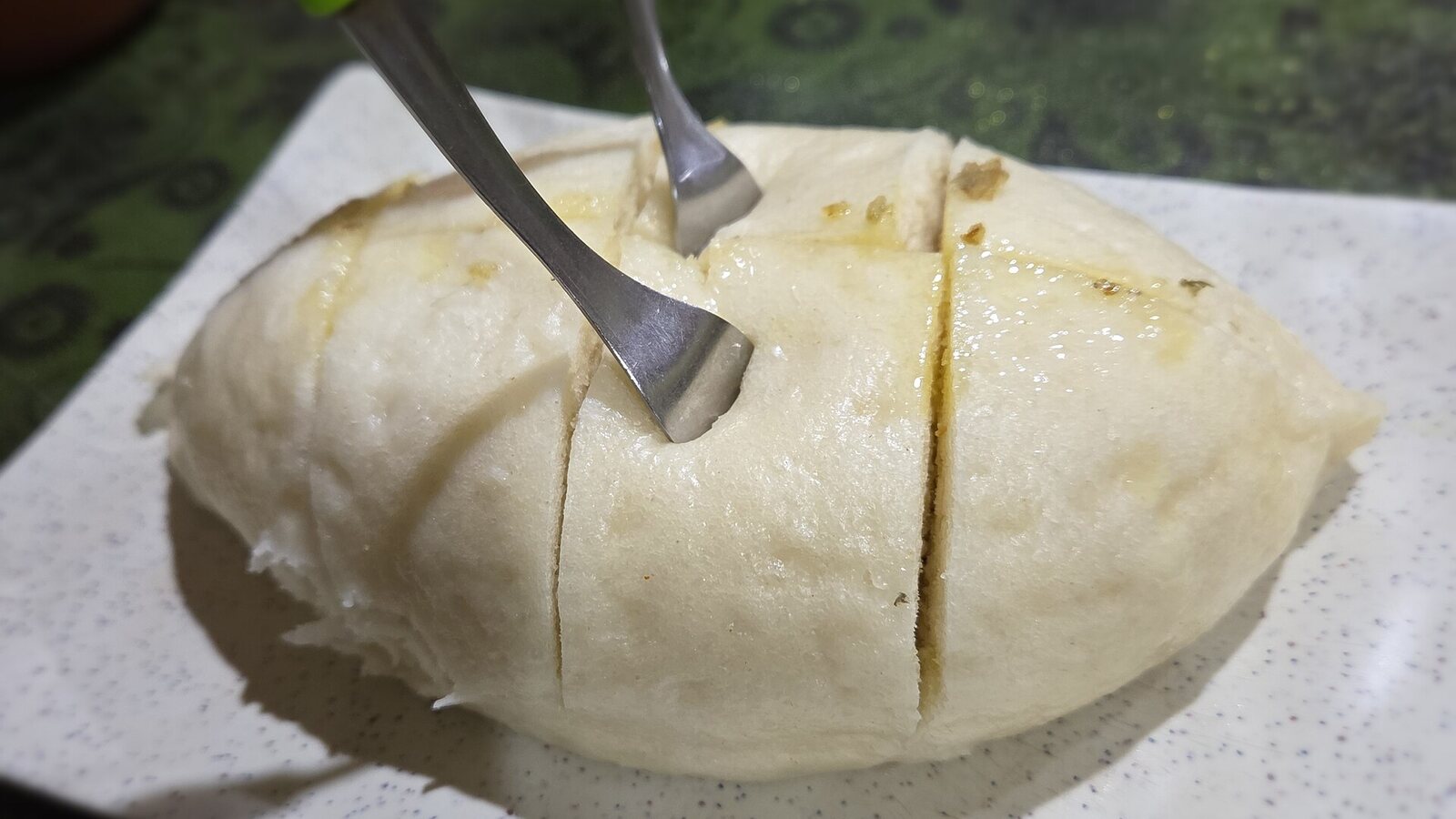
Siddu
Overview
If the Himalayan hills have a signature bread, it is siddu. Soft, pillowy, and faintly sour from a long ferment, siddu is a steamed wheat-flour bread that is most often split open and eaten hot with a spoonful of ghee, a bowl of dal, or a sharp mint chutney. It is the kind of food that belongs to cold weather and slow mornings — the dough is mixed, left to rise for hours, stuffed with a savoury or sweet filling, and then steamed until it swells into a glossy, dumpling-like loaf. For communities in Shimla, Kullu, Mandi, and the upper hill tracts, siddu is both everyday sustenance and a dish tied to identity, season, and the rhythm of mountain life.
Unlike the flatbreads that dominate the North Indian plains, siddu is defined by two things: fermentation and steaming. A yeasted wheat dough is proofed for four to five hours, stuffed with anything from a spiced urad dal paste to a paste of ground walnuts, and then cooked over steam — traditionally in a special steamer or even suspended over a boiling pot. The result is something between a steamed bun and a stuffed bread, with a tender crumb and a filling that turns molten inside. It is hearty, warming, and unmistakably of the mountains.
Background and Origin
A Bread of the Gaddis and the Hill Communities
The preparation techniques and origins of siddu are most often attributed to the Gaddi people, one of the indigenous shepherd communities of Himachal Pradesh, whose homeland centres on the Dhauladhar range and the upper reaches of Kangra, Chamba, and the surrounding districts. As the Silver Mountain School of Hotel Management’s profile notes, the Gaddis — transhumant herders who moved between alpine pastures and the low hills — needed food that was filling, portable, and made from what the hills could provide: wheat, walnuts, lentils, and ghee. Siddu answered all three needs. It could be prepared with a long, slow ferment that didn’t require an oven, and its dense, stuffed body made it an ideal one-dish meal for a day on the move.
Over time, siddu spread beyond the Gaddi community to become a staple across the hill districts, particularly in Shimla, Kullu, Manali, Rohru, and Mandi. It is now closely identified with the cuisine of the upper hills more broadly, though its heartland remains the Gaddi belt.
A Name with Cross-Border Roots
The etymology of the word itself hints at siddu’s place in a wider Himalayan world. According to GOYA magazine, some sources trace siddu to the Tibetan word tse-doe, meaning “steamed bread” — a reminder of the centuries of trade, migration, and cultural exchange that moved people, ideas, and food across the high Himalaya. NDTV Food describes siddu as “distinctly Himachali but [carrying] the fingerprints of centuries of mountain trade, migration, and cultural exchange.” Steamed breads appear in various forms across the Himalayan arc — from Tibetan momos to Nepali momocha — and siddu is the Himachali expression of that shared tradition.
A Winter Staple
In the hills, siddu is food for the cold months. When the temperature drops and fresh vegetables are scarce, a hot, ghee-slathered siddu is both comfort and calorie. It is eaten for breakfast and lunch, sometimes dinner, and is a common sight at roadside dhabas in Kullu and Manali during the tourist season, where it has become one of the dishes visitors most associate with a trip to the hills. For the diaspora, making siddu at home is a way of summoning the winter of the pahad — the smell of yeast and wheat, the anticipation of steam, the first cut into a hot loaf.
Key Features
Ingredients
The Dough
- Wheat flour is the base, sometimes combined with a little refined flour (maida) for a softer texture.
- Yeast — traditionally wild or brewer’s yeast, today usually instant dry yeast — is what makes siddu a fermented bread. A pinch of sugar feeds the yeast and speeds the rise.
- Salt and oil (or ghee) are added to the dough for flavour and pliability.
- Lukewarm water or milk is used to knead the dough. Milk, where used, makes a richer, softer siddu; water is the everyday version.
The Stuffing
The filling is what distinguishes a memorable siddu. The classic savoury stuffing is built from:
- Urad dal (split black gram), soaked and ground to a coarse paste, then cooked with spices.
- Walnuts, ground to a paste or chopped — a signature of the Kullu–Manali version, reflecting the walnut groves of the region.
- Green chillies, ginger, coriander, and basic spices (turmeric, garam masala, sometimes amchour) for heat and aroma.
- Poppy seeds or mixed nuts for sweet stuffings, which are a less common but traditional alternative.
Technique
Making siddu is a multi-step process that rewards patience:
- Mix and knead — Flour, yeast, salt, sugar, and a little oil are combined with lukewarm water (or milk) and kneaded into a firm, smooth dough.
- Proof — The dough is covered and left to rise for 4–5 hours in an oiled bowl, until it has roughly doubled. This long, slow proof in the cool hill air is what gives siddu its characteristic slight tang and soft crumb.
- Prepare the filling — While the dough proofs, the urad dal is soaked, ground, and cooked with spices; walnuts are ground; and the filling is cooled.
- Stuff and shape — The risen dough is divided into portions. Each portion is flattened into a disc, a spoonful of filling is placed in the centre, and the edges are sealed and shaped into a round or oval loaf. Some versions are left unstuffed and served plain with ghee.
- Steam — The stuffed loaves are placed in a steamer (traditionally a special utensil, or a covered pot with a little water at the bottom) and steamed for 15–20 minutes until puffed and cooked through. The steam — not an oven or tawa — is what gives siddu its glossy, dumpling-like surface and tender interior.
- Serve hot — Siddu is eaten immediately, split open, with a generous spoonful of desi ghee, a side of dal, or pudina (mint) chutney.
Regional Variations
- Kullu and Manali — The best-known version, often stuffed with a walnut paste or a walnut-urad dal mixture. This is the siddu most tourists encounter at hillside dhabas, served with ghee and chutney.
- Shimla and Rohru — A slightly more rustic siddu, often with a simpler urad dal or poppy-seed filling, and sometimes served with a bowl of mah ki dal (black lentil dal).
- Mandi — Mandi’s siddu is part of the same family but may be served alongside the region’s spinach-based dishes, with the bread acting as a vehicle for the local gravies.
- Sweet versions — In some households, a sweet siddu is made with a filling of poppy seeds, jaggery, or mixed nuts, steamed the same way and eaten as a festive or winter treat.
How It Is Eaten
Siddu is not eaten alone. The canonical serving is hot siddu, split, with a spoonful of ghee melting into the crumb, accompanied by a bowl of dal (often mah ki dal) and a sharp green chutney — most often mint (pudina) or coriander. The combination of the bland, steamed bread, the rich ghee, the earthy dal, and the bright chutney is what makes the dish sing. In dhabas it may be served with a side of paneer curry or a simple vegetable dish; at home it is often a one-bread meal.
FAQ
What is siddu?
Siddu is a traditional Himachali steamed, fermented wheat bread. A yeasted wheat-flour dough is proofed for several hours, stuffed with a savoury filling (most often spiced urad dal, walnuts, or both) or occasionally a sweet filling, and then steamed until soft and puffed. It is most popular in the hill districts of Shimla, Kullu, Mandi, and the surrounding region, and is typically eaten hot with ghee, dal, and mint chutney.
Why is siddu steamed rather than baked?
Steaming is a defining feature of siddu and reflects both its Himalayan context and practical history. In the high hills, ovens were not traditionally common, and steaming over a pot of boiling water required no specialised bakery equipment. Steaming also gives siddu its signature soft, dumpling-like texture and glossy surface — very different from a baked or tawa-cooked bread. The technique links siddu to a wider family of steamed Himalayan breads, from Tibetan momos to Nepali steamed buns, and some sources trace the name itself to the Tibetan tse-doe, meaning “steamed bread.”
What are the most common fillings for siddu?
The most traditional savoury filling is urad dal (split black gram), soaked, ground, and cooked with ginger, green chillies, coriander, and spices. In the Kullu–Manali region, ground walnuts are a signature addition, reflecting the local walnut harvest. Other savoury versions use poppy seeds, paneer, or green peas. Sweet stuffings — made from poppy seeds, jaggery, or mixed nuts — are less common but traditional in some households, especially during festivals.
Who first made siddu, and where does it come from?
Siddu’s preparation techniques are most commonly attributed to the Gaddi people, an indigenous shepherd community of Himachal Pradesh whose homeland centres on the Dhauladhar range. As transhumant herders, they needed food that was filling and made from what the hills provided — wheat, walnuts, lentils, and ghee. From the Gaddi belt, siddu spread to become a staple across the upper hill districts, including Shimla, Kullu, Manali, and Mandi, where it is now a defining dish of the local cuisine.
Where can readers learn more about siddu?
For a cultural profile, see NDTV Food’s feature on why siddu is at the heart of Himachali life. GOYA magazine covers the etymology and Himalayan trade connections. For a recipe-focused treatment, The Mad Scientist’s Kitchen and Foodomania both give detailed, authentic instructions for making siddu at home. The Wikipedia entry on Siddu is a good quick reference for the basics.